There are films that spark cultural conversation. There are films that provoke thought and intrigue. There are films that can shape societal movements. Then, there are films like Don’t Worry Darling, which descend into such a perfect storm of gossip, speculation, and utterly unhinged internet behaviour that the film itself becomes almost irrelevant…and also, irresistible. The marketing campaign of Don’t Worry Darling (and the media storm surrounding it) was not just a film release, it was a digital spectacle. A months-long theatre of chaos in which everyone had a role: director, actors, stylists, TikTok sleuths, Twitter stans, Harry Styles’ obvious sleep-deprivation, and Chris Pine’s vacant stares.
Don’t Worry Darling began with a promise: a high-concept psychological thriller, a buzzy female director, a wildly attractive and talented cast, and the post-pandemic hunger for something interesting. What followed was an avalanche of rumours, on-set tension, weaponised interviews, cryptic Instagram captions, and a single video clip that led millions of people to genuinely debate something so mind-numbingly innocuous that you felt crazy for arguing for either side: Did Harry Styles spit at Chris Pine at the film’s premiere?
This is not a review of Don’t Worry Darling. It’s a timeline. A character study. A cautionary tale. A breakdown of how a mid-tier film became a masterclass in unintentional marketing through sheer mess. Sardonic? Yes. Petty? Often. But beneath the Aperol Spritzes in Valentino outfits and “Miss Flo” moments is a sharp lesson in the currency of chaos.
What was Don’t Worry Darling supposed to be?
Don’t Worry Darling had all the ingredients of a hit: the psychological intrigue of The Stepford Wives, the hyper-stylised aesthetic of a high-fashion perfume ad, and the promise of female-forward storytelling™. Directed by Olivia Wilde, the film stars Florence Pugh as Alice, a seemingly perfect 1950s housewife living in an eerily pristine desert town with her husband Jack (played by Harry Styles) and a mounting sense of dread.
It was Wilde’s second directorial feature after 2019’s critically acclaimed Booksmart, and her first to promise a more serious tonal shift. She was lauded for championing a “new era of female-centred thrillers”, citing influences like Inception, The Truman Show, and The Matrix. In early interviews, she framed the film as a critique of patriarchal control dressed in the glossy packaging of domestic bliss.
What is Don’t Worry Darling actually about?
On the surface, the film follows Alice and Jack as they live an idyllic life in Victory, a seemingly utopian company town run by the enigmatic Frank (played by Chris Pine). During the day, the men go off to work at the mysterious “Victory Project”, while the women stay home, drink cocktails, and compete for Best Dressed. Then, during the evening, the women dutifully endure their traditionally and patriarchally expected wifely duties. Cracks begin to form when Alice experiences hallucinations, memory glitches, and develops a growing paranoia that something isn’t right in Victory.
Eventually, we learn – spoiler alert – that Victory is a simulation, a tech-based virtual reality built by insecure men in the real world who’ve abducted or coerced women into living inside a 1950s fantasy. Jack, it turns out, was one of them. He chose to bring Alice into this reality without her consent. The real world is grim, grey, and painfully modern, and the film’s central tension is about female autonomy versus male control disguised as devotion.
At its core, Don’t Worry Darling is about illusion. Specifically, how the systems we live in are designed to make women doubt their own reality. There was an air of Oscar potential and Letterboxd supremacy. It was a simpler time…
So, what the hell went so wrong?
The casting was buzzy. The styling was impeccable. The trailer was thrilling. And don’t even get me started on how absolutely rabid the fanbases were.
Well, let’s take a look…
Early promise. Early cracks.
At first, everything looked enviably smooth. Don’t Worry Darling was officially announced in late 2019 after a bidding war among 18 different studios to acquire Olivia Wilde’s second directorial feature was eventually won by New Line Cinema. The initial spec script for Don’t Worry Darling, written by brotherly writing duo Carey and Shane Van Dyke (Dick Van Dyke’s grandsons, no less), had appeared on the 2019 Black List, an annual survey of the most liked feature film screenplays that were not yet produced. Some famous examples of Black List screenplays include Bohemian Rhapsody, The King’s Speech and The Social Network.
After the project was greenlit, Wilde brought in screenwriter Katie Silberman to revise the script into something more stylish, more psychological, and more in keeping with Wilde’s emerging reputation for cool-girl feminism™. By the time the screenplay’s final draft circulated, the tone had shifted: it was less Get Out and more The Stepford Wives meets Black Mirror by way of OK! Magazine. That’s not an insult; it’s brand positioning.
Controversy can make or break a film.
Before we dive headfirst into the beautifully chaotic timeline that is Don’t Worry Darling, it’s worth noting that controversy in film isn’t inherently a death sentence. Sometimes, it’s quite the opposite.
A perfect example of this would be when Ridley Scott’s All the Money in the World faced a massive PR crisis of having cast Kevin Spacey in an integral role. Just weeks before the film’s December 2017 premiere, serious allegations were made against Spacey, and the studio made a very bold decision: reshoot every single one of Kevin Spacey’s scenes with Christopher Plummer instead. An accelerated schedule? With a new actor? All to be done weeks before hitting cinemas? What could possibly go wrong?
Against all odds, it worked. The recasting became part of the film’s press campaign. It turned what could’ve been a full collapse into an act of reputational salvage. Plummer was nominated for an Oscar. The film came out mostly unscathed. That kind of controversy? Managed and controlled.
However, even the reshoots for All the Money in the World weren’t without their controversy. Spacey had only worked for 10 days on the film, and Plummer was brought in for 9 days to reshoot those scenes. The film’s leads, Michelle Williams and Mark Wahlberg, returned for the reshoots. While it was initially reported that the actors filmed the reshoots for free, it was later revealed that Wahlberg had been paid $1.5 million, whereas Williams had been paid $80 a day, so a whopping $720 in total. Following the understandable backlash to the pay discrepancy, Wahlberg donated his additional $1.5 million salary to the Time’s Up Legal Defense Fund in Williams’ name.
But Don’t Worry Darling was not All the Money in the World. It wasn’t one controversy; it was a hydra of them. Interpersonal drama. Casting chaos. Romantic entanglements. Leaked video messages. Custody papers. Fan theories. Spit conspiracies. It was a full-blown content ecosystem. Marketing departments both cheered and hired in-house counsellors.
Controversy can make a campaign, yes, but only if you’re intentionally steering the chaos. But, if the chaos starts steering you? That’s another story entirely. So, now that we understand the stakes, let’s get into this mess. It’s a long, chronically online ride – so strap in.
A series of unfortunate events…
April 2020
Florence Pugh signed on as Alice and was immediately positioned as the film’s emotional core. At the time, Pugh was riding a career high off the one-two punch of 2019’s Midsommar and Little Women, the latter of which earned her an Academy Award nomination. She was also announced to star opposite Scarlett Johansson in the then-forthcoming Marvel film Black Widow.
Opposite Pugh, Shia LaBeaouf was cast as Jack, the clean-cut company man with a sinister undertow. It was a provocative pairing: a rising prestige actress with serious critical cachet and an intensely volatile actor known for going too far in pursuit of a role. For a moment, the combination seemed promising. But, if Don’t Worry Darling was ever on solid ground, this is where it started to crack.
September 2020
So, this is where things start to get messy. Shia LaBeouf exited Don’t Worry Darling in September 2020, citing the industry-standard explanation of “scheduling conflicts”. Now, a little bit about “scheduling conflicts”. This is always code for “we didn’t get along on set and don’t want to admit that”. Film production moves FAST, there are so many integral moving parts that if one cog stops turning properly, it could cost the production upwards of (and possibly over) $100,000 a day. While there is no official probation period when it comes to production, you can almost think of these “scheduling conflicts” excuses as that. A guilt-free way of saying, “Sorry, we don’t think you’re right for the role, but we’ll be diplomatic about it”. So, as with most “scheduling conflict” situations, no one believed it. Reports soon surfaced that LaBeouf’s on-set behaviour had clashed with Wilde’s approach as she had a “zero assh*les” policy as a means of safeguarding her cast and crew. All of this to say that it was widely reported that LaBeouf had been fired by Wilde.
This early disruption was quietly swept under the rug. But as the chaos would later reveal, nothing stays buried on the Internet for long.
October 2020
LaBeouf’s departure meant that the film’s second lead role was now vacant…and in comes Harry Styles. Replacing LaBeouf meant more than just a change in casting; it fundamentally altered the film’s chemistry, its marketing strategy, and its entire online footprint. Styles brought with him a charming face, a well-tailored waistcoat, and an army of millions upon millions of fans, Tumblr veterans, TikTok creators, and parasocial devotees primed to obsess over everything he touched. In their eyes, this was no longer just a buzzy psychological thriller, this was a Harry Styles movie. And whether Wilde liked it or not, she’d just cast the internet’s boyfriend in a role that was about to blur every boundary between fiction and reality.
January 2021
Paparazzi photos of Wilde and Styles holding hands at a wedding in Montecito hit the internet, and that was that. The relationship was no longer a rumour, it was canon. The photos went viral within hours. Tabloids reported that they were “smitten”. TikTok spun up endless theories about an on-set romance, jealous co-stars, and love triangles that may or may not have existed.
At the centre of it all? Florence Pugh. She said nothing. She liked nothing. She posted nothing. And yet, the silence was deafening.
The optics of this situation were complicated, to say the least. Wilde was the director. Styles was the co-lead. Pugh was the lead, left to shoulder the weight of a film whose promotional identity was rapidly shifting away from feminist thriller and toward pop culture spectacle. The speculation didn’t just stay on social media. It started to bleed into more formal press coverage, where questions about on-set dynamics and professionalism couldn’t be dodged quite so easily.
Further complicating the matter, Wilde still hadn’t publicly split from her partner of nearly 10 years, Jason Sudeikis. This only added fuel to the fire. Timelines were blurred, allegiances were questioned, and while the film was still deep in production, its public narrative was already spiralling out of control.
April 2022
CinemaCon is an annual convention for theatre owners where each major studio puts together a star-studded presentation to advertise their upcoming releases. 2025’s CinemaCon saw the likes of Ariana Grande and Cynthia Erivo presenting Wicked: For Good, Tom Cruise presenting Mission: Impossible 8, and Zoe Saldaña presenting Avatar: Fire and Ash. Safe to say that CinemaCon is a big event that studios take very seriously.
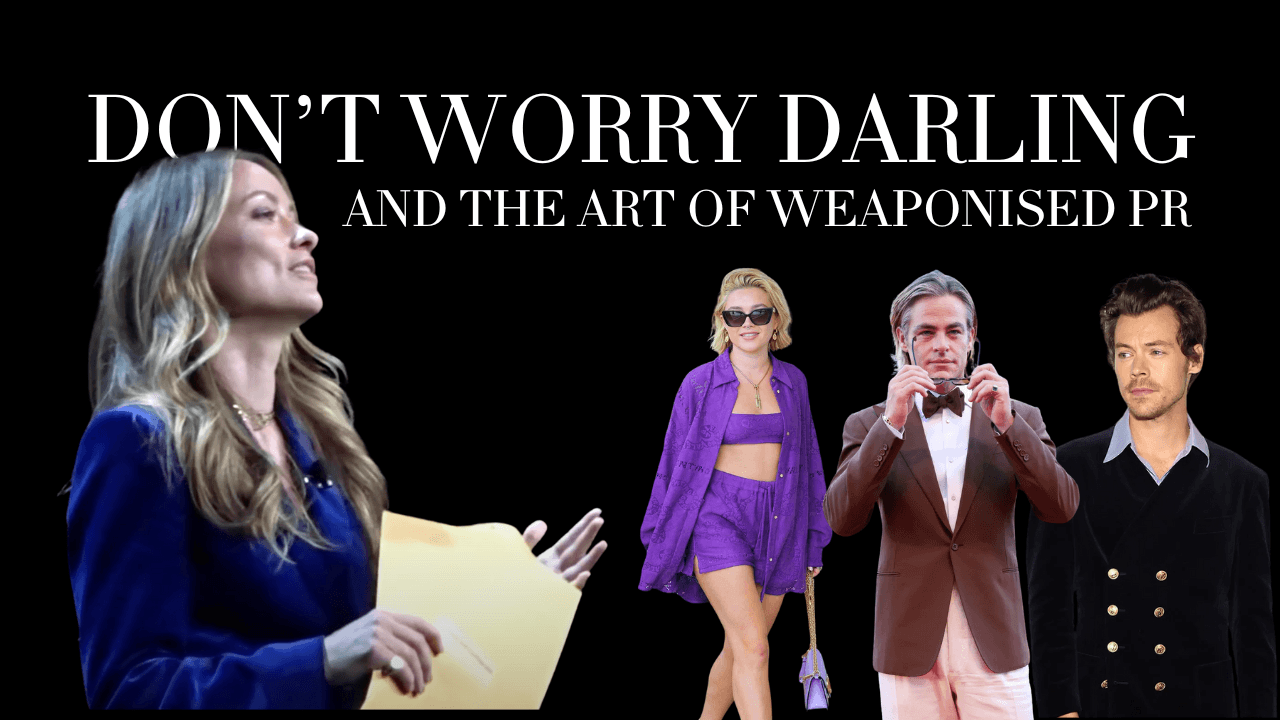
In April 2022, Wilde appeared to present Don’t Worry Darling, as despite the controversy, there was still great hope that it could be a huge critical and financial success. Midway through her presentation, someone walked up to the edge of the stage and slid a large manila envelope toward her. Wilde paused, opened it, and read the contents. It was a set of custody papers from Jason Sudeikis.
Initial reports described the moment as awkward but uneventful. Then the internet got involved. Videos were slowed down. Body language was analysed. It was confirmed that the envelope had been intentionally delivered in front of a live audience of journalists and studio executives. Sudeikis’ camp insisted he hadn’t planned the public nature of the delivery, but no one really believed that. She had publicly embarrassed him, and he did the same to her. Suddenly, the behind-the-scenes story wasn’t just about a messy production. It was about a messy breakup, an escalating PR war, and a film that now felt like collateral damage.
August 2022
Enter Shia LaBeouf, again. In an interview with Variety, Wilde claimed she had fired LaBeouf from the production to protect the cast and secure a “safe and trusting environment”, particularly for Pugh. It was a clean narrative. It cast Wilde as a director with integrity, positioned Pugh as the priority, and quietly reinforced the idea that Styles had been the better choice all along.
Then, LaBeouf responded.
He provided text messages, emails, and, most damningly, a full video message from Wilde in which she refers to Pugh as “Miss Flo” and urges LaBeouf to stay on the project, saying she’s “not ready to give up on this yet”. The video went viral…and so did the nickname. “Miss Flo” became a meme, a catchphrase, and an undeniable crack in Wilde’s carefully managed public persona. The message was clear: someone wasn’t telling the full story. And by the time the film reached the prestigious Venice Film Festival, it was no longer a matter of whether things were tense. It was a question of how much worse it could get.
September 2022 – Part 1
By the time Don’t Worry Darling arrived at the Venice Film Festival, the press narrative had completely overtaken the film itself. What should have been a victory lap for a buzzy psychological thriller instead became a live-action re-enactment of every rumour, feud, and meme that had defined the film’s increasingly chaotic promotional cycle.
Florence Pugh did not attend the official press conference, with the official reason given that her flight from the set of Dune: Part Two in Budapest would not arrive in time. Technically true, but also incredibly conveniently timed. She appeared in Venice later that day in a purple Valentino set, sunglasses firmly in place, holding an Aperol Spritz. The internet treated it like a royal entrance.
Meanwhile, the press conference unfolded with all the tension of a hostage video. Wilde was asked directly about her rumoured falling out with Pugh and offered an answer so noncommittal it only confirmed suspicions. “Florence is a force”, she said. “As for all the endless tabloid gossip and all the noise out there, I mean, the internet feeds itself.” She smiled, but not too much.
Chris Pine sat beside her, gazing into the middle distance like a man wondering if his publicist could still get him out of this. Styles, when asked about acting, responded with the now-infamous quote: “My favourite thing about the movie is that it feels like a movie.” The room went still. Journalists blinked. Twitter took care of the rest. Granted, Styles’ inane comment can be attributed to his obvious sleep deprivation, given that his then-ongoing world tour was in full swing.
Then came the premiere. Everyone was there. Everyone was watching. And no one was making eye contact.
Pugh stood as far from Wilde as geometry would allow. Pine positioned himself like Switzerland. Wilde and Styles sat apart. The cast clapped at staggered intervals, smiled in different directions, and interacted like actors forced to pretend they’d never been in the same WhatsApp group. And then, the spit.
A slowed-down video surfaced, showing Styles taking his seat next to Pine. As he leans in, Pine freezes, glances at his lap, and smiles awkwardly. Within hours, Twitter had declared it: Styles had spat on Pine. Freeze frames circulated. Lip movements were analysed. Conspiracies were theorised. The phrase “Spitgate” began trending globally. Pine’s publicist categorically denied it, and Styles later joked on stage in New York that he had “just popped over to Venice to spit on Chris Pine.” The moment was never confirmed, but it didn’t matter. The meme had already been canonised.
Then, at the New York premiere, Pugh didn’t attend while Wilde insisted that everyone got along. Ultimately, the film opened to deeply mixed reviews.
September 2022 – Part 2
Don’t Worry Darling opened in cinemas worldwide amid a swirl of discourse so thick it practically required a machete. By this point, most people knew one of two things about the film:
- Florence Pugh was excellent in it.
- Absolutely no one involved liked each other.
Critics were unkind, to say the least. The consensus was that the film was visually sleek but thematically shallow. The plot, while ambitious, was accused of being undercooked and derivative. Most agreed that Pugh delivered a commanding performance that carried the film, while Styles’ turn as Jack was described as passable at best and bafflingly miscast at worst. Wilde’s direction was praised in places for its confidence, but the script was criticised for lacking subtlety and coherence. Some called it a film with “great vibes and bad ideas”. Others were less generous.
The final Rotten Tomatoes score settled at a disappointing 38%, and the film’s ambitions for awards recognition quietly evaporated. It did, however, manage to open at number one at the US box office, bringing in around $19 million domestically in its opening weekend and eventually grossing nearly $90 million worldwide on a $35 million budget. Now, this is pretty good. For a film to be considered profitable, it generally needs to earn 2.5 times its stated production budget. Sometimes, this official budget includes marketing costs, but this was not likely for the film, given the initial hopes that it would be a huge financial success. Thankfully, Don’t Worry Darling was at least profitable, as it quite literally made 2.5 times its production budget, with a final global total of $87.6 million. So, on paper, it was a success. However, reputationally, it was something murkier.
The drama surrounding the film undoubtedly boosted its financial performance. The press coverage made it impossible to ignore, which is a very good thing when a wide-release film is coming. You want as many eyeballs on the film as possible pre-release so that people will go to see it at the cinema. People bought tickets just to see what all the fuss was about. But it wasn’t the kind of success that creates lasting goodwill. It was spectacle-driven. One and done. Don’t Worry Darling did not do well with return business.
The film people talked about far more than they remembered. It was far more famous for the memes than the monologues. And for the people behind it, that may have been the biggest disappointment of all.
October 2022 and Beyond
So, the film was out, and the dust was starting to settle. Or, at least it stopped trending every other day. Don’t Worry Darling quietly finished its run in cinemas, and while the drama didn’t entirely fade, it eventually became cultural background noise. By the time awards season rolled around, it was absent from all major ballots. The only thing it won was Best Gossip of the Year.
From a marketing perspective, Don’t Worry Darling is fascinating. Not because the campaign was a success, but because the marketing team had to execute a full-on damage control manoeuvre in real time, on an international stage, while the internet burned everything they put out.
The original marketing plan had leaned heavily into aesthetics and intrigue: clean mid-century visuals, a curated drip-feed of plot details, and the visual capital of Florence Pugh and Harry Styles on-screen together. It was all mood boards and mystery. But as the off-screen narrative began to spiral, the campaign had to pivot.
Instead of pushing plot or theme, Warner Bros. leaned into visual assets. They flooded Instagram with stills. They amped up the retro-futurist production design. They leaned on Harry Styles’ fanbase as a built-in street team, knowing full well that the majority of online buzz was happening in their corner of the internet.
On TikTok, the campaign became increasingly reactive. Official accounts reposted edits made by fans, participated in subtle meme culture, and amplified positive content, while trying to ignore the viral “Spitgate” breakdown and “Miss Flo” stan videos that were racking up millions of views. At a certain point, it stopped being about managing the message and became about surviving the message.
This is where the real takeaway emerges. Because in most cases, when a film suffers from this level of behind-the-scenes dysfunction, the response is to go quiet. To shut it down, go into hiding, and let the project die on its feet. Don’t Worry Darling didn’t do that. It showed up awkwardly, tensely, with a smile that didn’t quite reach anyone’s eyes. But it showed up. The team, whether through strategy or necessity, pressed on. Venice went ahead. Press junkets continued. The film opened wide. A testament, in its own strange way, to Olivia Wilde. She believed so much in this film that she endured the drama that was happening all around her. Only a team of very expensive publicists will know for sure exactly where the truth ends and the fluff begins.
The campaign was a masterclass in PR perseverance: keep moving, keep posting, and keep nodding politely while the internet writes fanfiction about your cast hating each other. There’s a lesson in that, albeit a brutal one: sometimes, you just have to weather the noise.
For studios and brands watching from the sidelines, the message is clear. In an age of internet-fuelled speculation and parasocial meltdown, control is an illusion. You will never own the narrative, you will only participate in it. But if you can participate with stamina, enough aesthetic coherence, and enough refusal to die quietly, you might just scrape together a win. And if not a win, then at least a viral moment. And in this economy, that’s sometimes enough.
This is not the campaign they planned.
Marketing a film is now more about internet-driven storytelling than anything else that is deemed more traditional. Marketers can no longer merely tell audiences what a film is about, they have to keep up with what audiences say it’s about. And more often than not, what audiences are saying has very little to do with what’s in the press release.
Gone are the days when a poster reveal and a few talk show appearances could carry a film. Today, a campaign is as much about digital presence as it is about the film itself, and it’s often the fans, not the studios, driving the conversation. That conversation might involve quotes taken wildly out of context, meme templates, fancams, leaked footage, fake seating charts, and conspiracy theories about spit.
The reality? You’re not running a campaign. You’re navigating a content ecosystem.
So, what does that actually look like?
- TikTok is the frontline of hype. It’s where films are reinterpreted through audio trends, fancams, edits, and stitched reactions. If your film isn’t getting traction there, it risks being irrelevant to an entire generation of viewers.
- X is the real-time reaction machine. It’s where cast dynamics are scrutinised to death, throwaway quotes become cultural canon, and every PR slip is immortalised within 90 seconds of going live.
- Instagram is the visual portfolio. It sells the look, not the story. Posters, behind-the-scenes stills, red carpet photos… This is where films become fashionable.
- YouTube is still the home of trailers, interviews, and press junkets. But it’s also where fan dissections, video essays, and meme edits now outperform official uploads.
- Letterboxd and Reddit are the backchannel. The cultural commentary. The real reviews. Letterboxd has especially become a curated chaos zone of 5-star sarcasm, fan humour, and sharp takedowns. One bad pull quote, and you’re immortalised in irony.
Film Twitter (yes, I know it’s X) and Letterboxd intersect as cultural battlegrounds, and once your film enters those spaces, it is no longer just a piece of media. It becomes discourse. Aesthetics are weaponised. Allegiances are formed. Quotes become inside jokes, and emotional arcs are reframed into 30-second “problematic fave” montages. The line between audience and PR machine? Blurred beyond recognition.
Traditional publicity relied on control by way of embargoes, press kits, and rehearsed interviews. But the internet thrives on speed, leaks, and chaos. You don’t get to steer the story anymore. You just try to stay afloat.
And Don’t Worry Darling is the textbook case of what happens when you lose control and go viral anyway. It wasn’t just promoted online. It was picked apart, reframed, and memed into oblivion. The campaign wasn’t just off-script; the audience was writing a completely different film in real time.
Film marketing today isn’t about the message. It’s about momentum. And sometimes, the only thing left to do is smile through the meme storm and hope the fan edits are flattering.
From headline to footnote
It’s 2025, and Don’t Worry Darling isn’t really remembered as a film. It’s remembered as a fiasco. Not a disaster in the traditional sense. It didn’t flop financially, no one’s careers imploded, and it certainly wasn’t the worst-reviewed film of 2022. But its real legacy lives in memes, reaction images, fan edits, and the postmortem social media threads that refuse to die.
The key players moved on, quickly and quietly, hardly uttering a single word about the sinking ship that everyone involved couldn’t jump from quickly enough. Florence Pugh went straight into Oppenheimer and Dune: Part Two. Harry Styles finished his world tour and quietly retreated from acting. Olivia Wilde vanished from the director’s chair (at least temporarily). Chris Pine kept on doing Chris Pine.
Don’t Worry Darling hasn’t aged badly, it’s just sort of stopped ageing in the public consciousness. It’s yet to become a cult favourite, spark a larger trend, or receive a reappraisal. It has simply faded. Like a glossy Instagram filter left out in the sun too long. And yet, the story around it still matters. It’s a perfect example of how modern entertainment now functions: part art, part spectacle, part endurance test. We no longer consume films in isolation. We consume the press tours, the TikToks, the memes, the feuds, the fan theories. We consume everything.
In the end, Don’t Worry Darling was never just a film. It was a microcosm of how art, gossip, commerce, and content now exist in one chaotic, symbiotic feedback loop. The film asked what happens when illusions crack under pressure, and then its own press tour answered that question in real time. It may not have rewritten cinematic history, but it did give us a case study in how to market a product when the product becomes the punchline.
Sometimes, the only way out is through. Preferably in Valentino with an Aperol Spritz.